
Debate over Putul's Appointment: Nepotism allegations cloud WHO regional role
Reza Mahmud :
Saima Wazed, the World Health Organization’s (WHO) Regional Director for South-East Asia (SEARO), has faced scrutiny following allegations surrounding her appointment. She is the daughter of Sheikh Hasina, the deposed Prime Minister of Bangladesh, who has been accused of human rights abuses.
The Bangladeshi government has called for Sheikh Hasina to be extradited to face these charges.
Saima, widely known as ‘Putul’ in Bangladesh was elected to the WHO position by regional leaders in November 2023 amidst claims that her mother may have unduly influenced the election process.
When contacted, Professor Dr M. Muzaherul Huq, a former Adviser to the WHO, told The New Nation on Saturday:
“Regional Directors are appointed by the WHO Executive Board in agreement with the Regional Committee.
WHO’s legal counsel had noted that, despite a decision by the World Health Assembly to implement a process for assessing the qualifications of all candidates, concerns remain about compliance with this protocol.
“In cases involving election campaigns, it is appropriate for national authorities to investigate. Saima’s appointment is reportedly under investigation to determine whether any misconduct occurred during the election process involving member countries.”
The expert added that
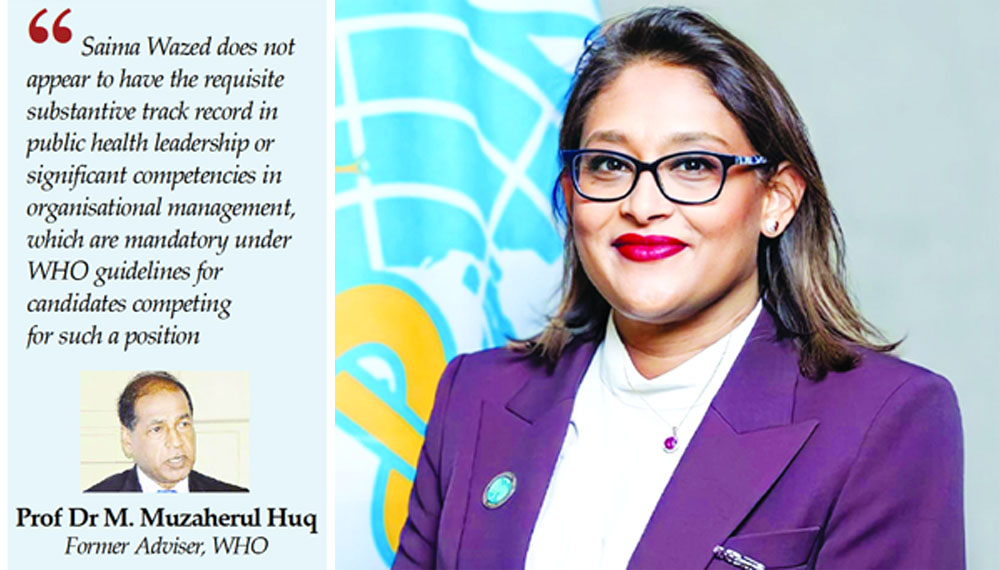
Saima Wazed does not appear to have the requisite substantive track record in public health leadership or significant competencies in organisational management, which are mandatory under WHO guidelines for candidates competing for such a position.
In August 2024, Sheikh Hasina fled Bangladesh following an uprising against her government, prompted by its heavy-handed crackdown on student protests. Both Hasina and her daughter are currently in India, where Saima is based at the WHO SEARO office in New Delhi.
This week, General Akhtar Hossain, Director of Bangladesh’s Anti-Corruption Commission (ACC), confirmed that the commission’s investigation into Sheikh Hasina would also encompass Saima Wazed’s appointment. Hossain informed journalists that there were suspicions of corruption linked to the election process.
The SEARO region, comprising 11 member countries including India and Pakistan, saw Nepal as the only nation to field a candidate against Wazed for the Regional Director role.
In a Health Policy Watch article published prior to Wazed’s election, public health expert Mukesh Kapila observed that her capability statement lacked evidence of “the strong technical and public health background and extensive experience in global health” required by the WHO for the position.
Kapila also noted that Saima did not meet the stipulated criteria of possessing “a substantive track record in public health leadership and significant competencies in organisational management,” as outlined in WHO guidelines.
He further commented that Sheikh Hasina’s efforts to introduce her daughter at prominent summits such as BRICS, ASEAN, G20, and the UN General Assembly could be seen as blurring the line between legitimate government lobbying and nepotism.
Despite these controversies, Saima, a psychologist specialising in autism, secured the position.
In 2024, the WHO Executive Board recommended expanding the code of conduct for Regional Directors to include provisions addressing “sexual misconduct, other abusive behaviour, and the disclosure of interests by candidates.” They also proposed stricter reference checks and enhanced reviews of qualifications and employment history.
Additionally, the Board suggested that member states nominating candidates should disclose any grants or aid funding provided to candidates within two years prior to their appointment.
Responding to reports of an investigation into Saima’s appointment, the WHO stated:
“If allegations of misconduct by or within a member state related to a WHO election campaign arise, it is appropriate for these to be investigated by the relevant national authorities. We would not comment on such investigations or related legal proceedings while they are ongoing.”
Under Article 52 of the WHO Constitution, Regional Directors are appointed by the WHO’s Executive Board “in agreement with the regional committee.”
A note from WHO’s legal counsel highlighted that, despite the 2012 World Health Assembly’s decision to establish a process for evaluating candidates’ qualifications, only the European Region has implemented such a mechanism.