
Chinese support to continue, Xi assures PM Hasina
Staff Reporter :
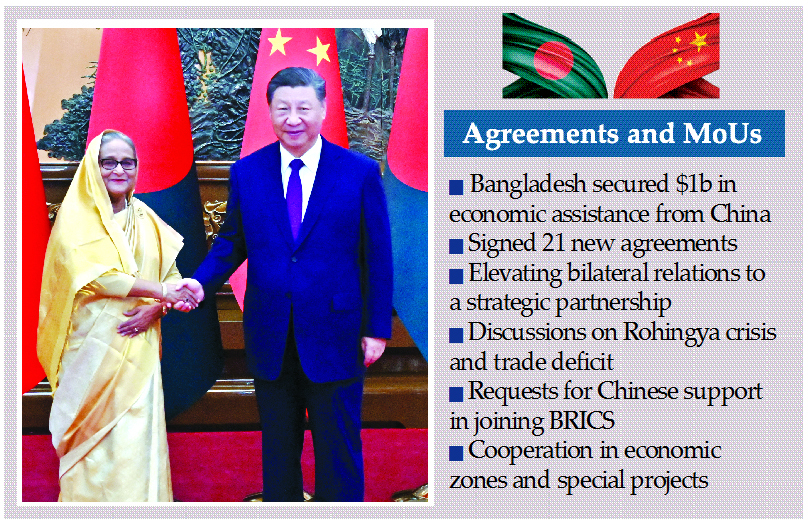
President Xi Jinping of China has assured Bangladesh Prime Minister Sheikh Hasina of his continued support for Bangladesh’s development. Meanwhile, Bangladesh has secured a significant pledge of $1 billion in economic assistance from China and signed 21 new agreements, elevating bilateral relations from development cooperation to a strategic partnership.
This major announcement came during a bilateral meeting between Prime Minister Sheikh Hasina and Chinese Premier Li Qiang at the Great Hall of the People in Beijing on Wednesday, as reported by Foreign Minister Hasan Mahmud.
Following productive bilateral talks, the leaders oversaw the signing of 21 instruments, including two renewed
Memorandums of Understanding (MoUs), and unveiled seven new projects.
These agreements encompass collaborations in the economic and banking sectors, trade and investment facilitation, digital economy initiatives, infrastructure development, disaster management assistance, and the construction of the sixth and ninth Bangladesh-China friendship bridges.
Furthermore, agreements were reached to enhance agricultural product exports from Bangladesh and foster people-to-people connectivity between the two nations.
Chinese Premier Li Qiang emphasised the deepening ties between Bangladesh and China, pledging $1 billion in economic assistance. He highlighted the historical roots of this relationship, recalling the visits of Bangabandhu Sheikh Mujibur Rahman in 1952 and 1957, which were further strengthened by Prime Minister Sheikh Hasina’s six visits to China.
In a cordial exchange, both leaders expressed their commitment to elevating bilateral relations to new heights. During the official visit, Prime Minister Sheikh Hasina extended invitations to Chinese President Xi Jinping, Premier Li Qiang, and other officials to visit Bangladesh next year, marking the 50th anniversary of diplomatic relations between the two countries. They agreed to commemorate this milestone in a significant manner.
Prime Minister Sheikh Hasina discussed several critical issues during her meeting with Chinese Premier Li Qiang.
Key topics included the Rohingya crisis and addressing the trade gap between Bangladesh and China. Hasina sought China’s cooperation in resolving the Rohingya crisis and proposed measures to reduce the trade deficit.
Premier Li Qiang responded positively, expressing China’s willingness to increase imports of Bangladeshi products such as leather goods, jute products, pharmaceuticals, and ceramics.
Economic collaboration was a significant focus, with Hasina inviting increased Chinese investment in Bangladesh’s 100 special economic zones and the Bangabandhu Industrial Park. She also highlighted the allocation of an export processing zone specifically for Chinese investors to foster greater economic cooperation.
Moreover, Hasina discussed Bangladesh’s aspirations to join BRICS (Brazil, Russia, India, China, and South Africa), a group of major emerging economies, and received assurances of Chinese support.
She also requested Chinese assistance to continue benefiting from Least Developed Country (LDC) facilities for at least three more years following Bangladesh’s expected graduation to a middle-income country in 2026, to which Premier Li Qiang responded positively.
Both leaders affirmed their commitment to promoting global peace and humanity, reflecting a shared vision for international cooperation and development.
Meanwhile, among the noteworthy instruments were a MoU between Bangladesh Sangbad Sangstha (BSS) Managing Director and Chief Editor Abul Kalam Azad and the China Media Group (CMG), along with an agreement with the Xinhua News Agency, reflecting deeper cooperation in media and communications.
The exchange of these documents solidifies the commitment of both nations to further elevate their longstanding relationship across various strategic domains.
The signed instruments are: Firstly, the two nations formalised the MoU on Strengthening Investment Cooperation in the Digital Economy, underscoring their commitment to advancing digital technologies and economic partnerships. This agreement is poised to facilitate innovation and growth in both countries’ digital sectors.
Additionally, a crucial MoU was inked between the China National Financial Regulatory Administration (NFRA) and Bangladesh Bank, focusing on banking and insurance regulatory cooperation. This initiative aims to enhance financial stability and regulatory frameworks between the two nations.
A Protocol of Phytosanitary Requirements for the Export of Fresh Mangoes from Bangladesh to China was also established, paving the way for smoother agricultural trade and ensuring the quality and safety of mango exports.
Moreover, agreements were reached on Exchange and Cooperation in Economic Development Policy, Trade and Investment Cooperation, and Strengthening Digital Economy Cooperation, reflecting a comprehensive approach to economic collaboration.
Furthermore, significant infrastructure projects were addressed, including the China-aid National Emergency Operation Centre and the renovation and construction of Bangladesh-China Friendship Bridges. These projects signify China’s continued support for Bangladesh’s infrastructure development and disaster management capabilities.
Healthcare and public health cooperation were also prioritised through the MoU on Strengthening Cooperation in Medical Care and Public Health, highlighting mutual efforts in healthcare advancement.
Environmental sustainability was another key focus, with agreements on Cooperation on Green and Low-Carbon Development demonstrating both nations’ commitment to addressing climate change and promoting sustainable practices.
Additionally, renewals and new agreements in media cooperation, education, and hydrological information provision underscored the breadth and depth of the bilateral engagement.
Apart from the MoUs, seven projects were also announced for further cooperation, which include the conclusion of the joint feasibility study on the China-Bangladesh free trade agreement, the commencement of negotiations on the optimisation of the China-Bangladesh bilateral investment treaty, the completion of the modernization of the telecommunication network for digital connectivity project, the completion of the trial run of the single point mooring with double pipe line project, the commencement of the Rajshahi WASA surface water treatment plant, the MoU between Shandong Agricultural University and Bangabandhu Sheikh Mujibur Rahman Agricultural University in Gazipur, and the construction of the Luban workshop in Bangladesh.
Meanwhile, Chinese President Xi Jinping, during a bilateral meeting with Prime Minister Sheikh Hasina at the Great Hall of the People in Beijing on Wednesday, reaffirmed China’s commitment to supporting Bangladesh’s development journey.
President Xi outlined China’s assistance to Bangladesh, which includes grants, interest-free loans, concessional loans, and commercial loans aimed at bolstering Bangladesh’s economy, said Foreign Minister Dr. Hasan Mahmud while briefing reporters on the key outcomes of the leaders’ meeting.
Hasan Mahmud also said that the Chinese president stated that joint technical committees from both countries would collaborate to determine the modalities of providing four types of financial assistance to support Bangladesh’s development.
Addressing the Rohingya issue proactively, Xi Jinping mentioned that China aims to contribute significantly to resolving the Rohingya problem through dialogue with the Myanmar government and the Arakan army.
He expressed gratitude to the Bangladesh prime minister for sheltering hundreds of thousands of Rohingyas in Bangladesh.
In response to the Bangladesh premier’s request for Chinese investment, President Xi emphasised China’s commitment to continuous and increased investment in Bangladesh.
Prime Minister Sheikh Hasina concluded her China visit on Wednesday, though she was scheduled to return home on Thursday from China. Hasan Mahmud said she would return home because her daughter Saima Wazed suddenly fell sick.