
Total solar eclipse expected on 8 April
News Desk :
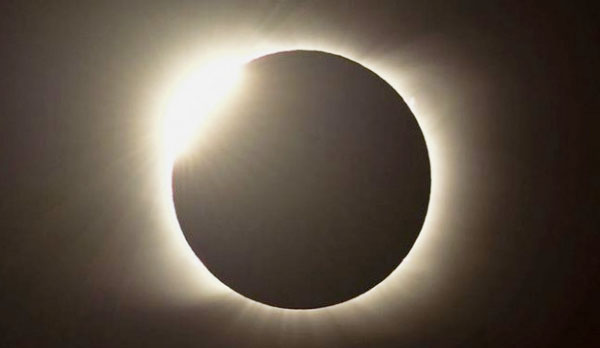
On April 8 much of the North American continent will witness the first total solar eclipse in 54 years. It will be the second in a set of three eclipses (called Saros) with the previous one appearing in 1970 and the next set to appear in 2078.
In this case the moon’s shadow will travel across much of North America at the speed of over 2,400km/h, resulting in a spectacle that won’t be seen again soon, says Jamie Carter of space.com.
This path of totality (the path of the moon’s dark shadow across the face of the Earth) will be narrow, at just 185 kilometres wide, and it will cross parts of Mexico, the US and Canada in a never-to-be-repeated route across the continent, lasting just 100 minutes.
Only from within that path will viewers experience darkness during the daytime, dropping temperatures and nocturnal animal behaviour – and only from within that path will it be possible to look at the totally eclipsed sun’s beautiful corona with the naked eye.
For most of the 40 million people living in the path of totality, it will be a once-in-a-lifetime event, but solar eclipses are the product of a long-term pattern that repeats on far bigger timescales than human life.
All solar eclipses come in families called Saros. Every 223 lunations – orbits of the moon around Earth – a near-identical moon shadow is projected onto Earth’s surface to cause an eclipse. That works out to 6,585.3 days, or 18 years, 11 days, 8 hours, according to NASA.
That eight hours is critical. It means that three solar eclipses following each other in the same Saros occur a third of the way around the globe.
The total solar eclipse on 8 April is part of Saros 139, which was responsible for a total solar eclipse across Africa 18 years, 11 days, 8 hours earlier, on 29 March 2006.
Precisely 18 years, 11 days, 8 hours after 8 April 2024 – on 20 April 2042 – the same Saros will produce a total solar eclipse in Asia.
Those eight hours, however, guarantee that a similar path of totality will revisit the same part of the globe every fourth repetition.