
Leather exports nosedive in 6 months
Muhid Hasan :
Export earnings from leather and leather goods have significantly been declined in first six months (July- December) in the current financial year of 2023-24.
Merchandise exports from this historically significant sector amounted to only $523.03 million in this period which was reduced by 17.93 percent year-on-year, according to Export Promotion Bureau (EPB) data.
Bangladesh’s export earnings from leather and leather goods in the first six months of the previous fiscal year were $637.29 million.
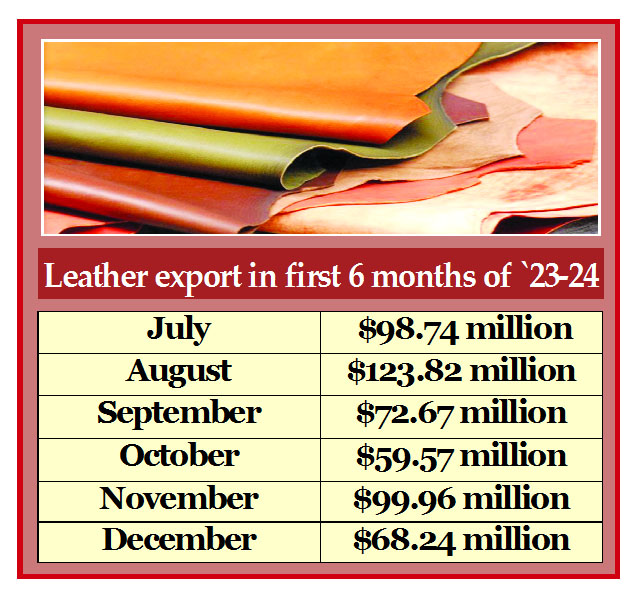
The EPB data showed that leather and leather goods exports were amounted to $98.74 million in July, August – $123.82 million, September – $72.67 million, October – $59.57 million, November – $99.96 million, and in December $68.24 million.
The export of leather and leather goods reached $1.24 billion in the 2021-2022 fiscal year, compared to $.0941.67 billion in the 2020-2021 fiscal year and $1.09 billion in 2019-2020 FY .
The sector has set a target of $1.35 billion for leather and leather goods exports in the 2024 fiscal year, with exporters aiming to reach $10 billion by 2030.
However, the country’s export earnings from leather and leather goods in July-December of FY24 fell 20.23 percent short of the government-set target of $655.71 million, the EPB data showed.
The EPB data showed that export earnings from leather footwear in the H2FY24 fell by 32.72 percent to $257.9 million compared to those of $383.31 in the same period of FY23.
According to the EPB data, export earnings from leather products apart from leather footwear in the first quarter of FY24, however, increased by 4.15 percent to $197.76 million compared to $189.88 million in the same period of FY23.
Industry insiders said, demand for leather and leather goods items decreased in the global market due to high inflation. On the other hand, a significant numbers of global buyers refused to source leather products from Bangladesh due to lack of environmental compliance.
Only a few renowned manufacturers in the country had gained the certification of Leather Working Group and doing business with the global brands.
However, the lack of product diversity is also a major reason to reduce leather and leather goods export, they expressed.
Many global buyers stopped procuring leather goods made with local raw hides due to the nonfunctional Central Effluent Treatment Plant at Savar Tannery Estate.
Bangladesh has 2 percent of the world’s total livestock population and can meet 1 percent of the world market’s leather demand, they added.
The leather sector of Bangladesh includes 200 tanneries, 3,500 MSMEs, 2500 footwear making units and 90 large firms.
Recently, a sustainable 205 industrial units Tannery Estate has been developed with CETP and STP and the production of eco-friendly leather and linkage industries-packing, lasts, adhesives, outsoles are growing rapidly.
Promising markets for Bangladeshi leather, leather goods, and footwear products include Germany, Italy, France, the Netherlands, Spain, Russia, Brazil, Japan, China, the UK, Singapore, Poland, the US, Canada, and Taiwan, among others.
Meanwhile, the government recently called for extending incentives to the leather industries, similar to the benefits provided to the readymade garments sector.
However, concerted efforts and strategic initiatives are needed to achieve the ambitious tenfold growth in its export earnings from leather and leather goods in the next seven years.
Khondaker Golam Moazzem, the research director of the Centre for Policy Dialogue (CPD), said that as exports continue to experience a regular decline, it will be a challenge for the sector to cope with the global market.
Dr. M. Abu Eusuf, professor of development studies at Dhaka University and the executive director of a national think-tank Research and Policy Integration for Development (RAPID), said the export target of leather and leather products by 2030 has been set at $12 billion.
A minimum 40 percent annual is growth required to reachthe target. However, we are stuck almost at the same amount of export that was in six years ago.
One of the vital reasons behind the decline in exports in the leather sector is that tanneries in Bangladesh are not certified by the Leather Working Group (LWG), a global body for the leather sector.
The main hurdles in getting this certificate are non-environmentally friendly leather processing, use of harmful chemicals and lack of proper waste management, M. Abu Eusuf identified.
Formation of a Leather Development Board, effective CETP, Tk500 crore interest-free loan for entrepreneurs (of which Tk300 crore for CETP and Tk 200 crore for individual ETP) and declaration of Central Bonded Warehouse for Tannery Industrial Estate should be provided to boost this potential sector, he suggested.