
Cyclone Mocha crosses Bangladesh coast

Staff Reporter :
The deadly cyclonic storm ‘Mocha’ had left behind a trail of destruction in several coastal districts and its surrounding areas while making its landfall on Sunday afternoon.
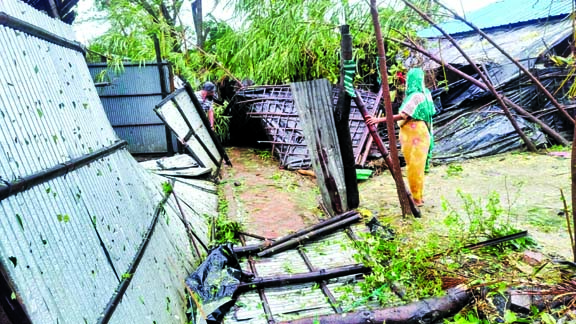
During its passage over the Naf River, the severe cyclone caused significant damage to St Martin, Teknaf, and Cox’s Bazar areas where numerous houses were flattened, and a vast number of trees were uprooted. Even about 11 people were injured due to the felling of trees in St Martin.
A number of electric poles were also uprooted in different parts of the coastal districts, causing disruption of power supply.
According to Bangladesh Meteorological Department, the centre of the very severe cyclonic storm ‘mocha’ crossed the Cox’s Bazar-North Myanmar coast near Sittwe at 3pm on Sunday and the storm was weakening gradually.
However, St Martin experienced severe havoc as the cyclone had caused extensive damage to the central part of the island, including Konarpara, Galachipa, Dokkhinpara, Pashchimpara, and Uttarpara, where at least 340 houses have been destroyed.
Several hundred trees had been uprooted as well. Coastal erosion has affected several villages in the northern, western, and eastern parts due to tidal surges.
Approximately 6,000 local residents, including three cyclone shelters, multiple educational institutions, and more than 37 hotels, resorts, and cottages, took shelter. The majority of them were women and children.
The Chairman of Saint Martin Union Parishad, Mujibur Rahman told the media that the situation on the island was somewhat normal in the morning. However, unusual conditions started to emerge after in the afternoon. From two o’clock, strong gusts of wind accompanied by rainfall intensified.
“The situation remains unchanged until four o’clock in the afternoon. As a result, houses and trees have been damaged. Around 10-15 people have been injured by falling trees, including one woman in critical condition. She has been admitted to the hospital for medical treatment,” he said.
Bibhishan Kanti Dash, the Coordinator of the Control Room of Cox’s Bazar District Administration and Additional District Magistrate (ADM) told the media that around 300-400 houses have been damaged by the strong winds. Several trees have also been uprooted. It has been reported that a woman has been injured by a fallen tree.
He further mentioned that some trees have also been uprooted in Shahpuri Island of Teknaf and Sabrang area.
Cox’s Bazar Chief Meteorologist of Weather Office Abdur Rahman told the media that on Sunday at around 3 pm, Saint Martin Island and the coastal areas of Teknaf were hit by the devastating cyclone.
“At around 3 pm, Saint Martin and the adjacent areas of Teknaf were struck by the cyclone. As a result, houses, trees, and electric poles in those areas have been severely damaged,” he said.
It is reported that in Cox’s Bazar areas experienced extensive damage to trees. Roofs of houses have been blown away, and in various areas, people have been seen removing fallen trees from the roads. Volunteers were working to relocate people from different parts of the city to shelters.
Upazila Nirbahi Officer (UNO) of Teknaf Mohammad Quamruzzaman told the media that the wind was blowing at a speed of over 200 kilometres per hour in Teknaf and its southernmost part Shahpori Dip along the Bay of Bengal.
“The weather is frightening because of the very high velocity of wind but we are yet to see the much feared massive tidal surges,” he said.
He said that the storm uprooted many trees and damaged houses and other structures in Teknaf.
Meanwhile, according to the Met Office bulletin, the Mocha was likely to cause heavy rain falls in Chattogram, Sylhet and Barishal ranging from 44 millimeter to 289 millimeter (mm).
Due to very heavy rainfall landslide may occur at places over the hilly regions of Cox’s Bazar, Bandarban, Rangamati, Khagrachari snd Chattogram, it warned.
It also asked all fishing boats and trawlers over North Bay to remain in shelter till further notice.
The bulletin said by the Sunday evening the whole cyclone would completely cross the coast as it was weakening gradually.
Before the landfall of the storm along the coastline of Bangladesh, the government took various initiatives including evacuation of tens of thousands of people and cattle for safety. Coast Guard, Navy and other law enforcers were ready for any emergency.