
Salt water makes Ctg-Cox’s Bazar highway risky
Chattogram Bureau :
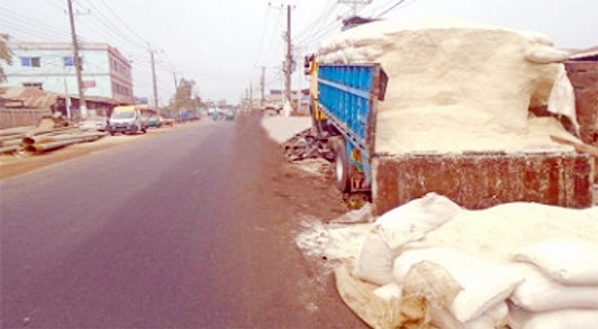
Chittagong-Cox’s Bazar highway has become risky. Tourists all year round visit this route of Cox’s Bazar. But the road has become a death trap due to transporting salt by truck with slower widening of the highway and higher cost of transportation through waterway. Transport drivers and workers on the highway said more accidents were occurring at 84 dangerous bends.
The number of cars and passengers is 4 times more than the road. There is reckless speed. Accidents are taking place as a result of narrow bridges and sitting on the side of the road in different areas.
Every day more than 500 valid AC-non-AC buses and local buses, 500 truck-pickups ply. Besides, illegal Nachimon-Karimon, four-wheeled trolley, easybike, CNG autorickshaw, four-wheeled open pickup vehicle run 2,000. As a result of transporting salt in open trucks, accidents often occur due to slippery roads in salt water. Meanwhile, efforts to widen the existing two-lane highway to 6 lanes and build an expressway have stalled. Sumon Singh, Executive Engineer, Roads and Highways, Dohazari Division, said the bends would be straightened from the end of construction of 6-lane road from Anwara section of Bangabandhu Tunnel to Moizjartek to Patiya Bypass. Then the bend from Patiya to Dohazari will be straightened. In this way, steps have been taken to straighten the curves step by step. JICA has expressed interest in upgrading the Chittagong-Cox’s Bazar highway to 8 lines.
Salt is cultivated in different areas including Shahpari Island, Maheshkhali, Ukhia, Kutubdia and Chakaria in Teknaf of Cox’s Bazar district. These salts are sent by sea and land to salt refineries in different parts of the country including Dhaka, Noakhali, Jhalokati and Comilla. Salt is brought by truck to refineries in Chittagong’s Majhirghat and Patia’s Indrapul area. Most of the salt is brought to Patiya as the transportation cost is less in Indrapul.