
Begum Khaleda Zia: A national leader beyond BNP
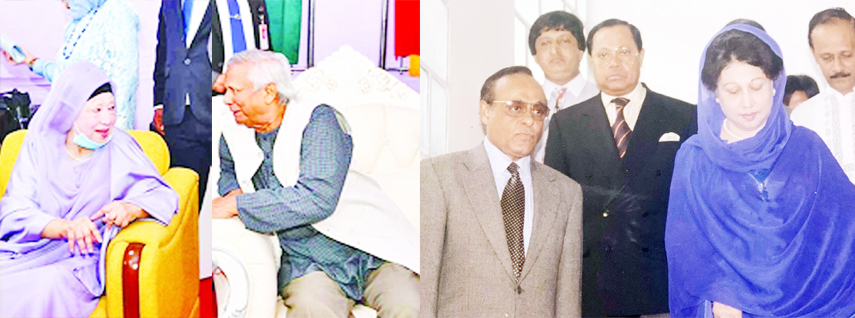
Dr. Md. Enamul Hoque :
Begum Khaleda Zia is one of the most prominent and influential political leaders in the history of Bangladesh. Begum Khaled Zia’s political career covered four decades, full of intense struggles, electoral triumphs, mass movements, political repression, and significant contributions to democratic changeovers.
 Despite huge personal losses, political setbacks, and years of incarceration, she remains a figure of courage, determination, and democratic aspiration not just for her party-the Bangladesh Nationalist Party (BNP)-but for vast citizens across political divides.
Khaleda Zia, born on August 15, 1945, in Dinajpur came into politics after the tragic assassination of her husband, Shahid President Ziaur Rahman, in 1981 at the age of only 45. Just after the assassination of President Ziaur Rahman, the founder of Bangladesh Nationalist Party (BNP) fell in a leadership crisis. Begum Khaleda Zia who was primarily a stay-at-home spouse with no prior experiences and involvement in politics came into the limelight of political landscape and was urged to lead the party.

The then political analysts of home and aboard were doubtful about her political performance at first. However, she demonstrated an astonishing ability to mobilize mass people, maintained party unity, and stood firmly against military dictatorship of H.M Ershad.
Her leadership character was further solidified when she led countrywide movements against General Ershad’s military regime in the 1980s. Her call for the restoration democracy accepted widely, and her non-compromising attitude earned her the admiration of common people. It was this phase of political activism that established her as a credible, national leader who could unite opposition forces and lead street movements.
Begum Khaleda Zia was elected the Bangladesh’s Prime Minister in the fifth general election in 1991 for the first time after the fall of H.M Ershad. This election marked the country’s return to formal democracy after nine years of military and autocratic rule under Ershad. Under her leadership, the government focused on stabilization of the democratic process, restoration of political institutions, and improvement of governance.
In her second tenure in 1996 she provisioned the Caretaker Government system in the constitution of Bangladesh at the demand of the opposition political parties.
In the third tenure during 2001-2006, her government made efforts to boost rural development nationwide, improved communication infrastructure, and increased food security.
It was under Khaleda Zia’s headship, Bangladesh managed to maintain a stable democratic structure, and economic growth despite non-cooperation, political rivalries of political oppositions headed by sheikh Hasina.
She holds the position of only female prime minister in South Asia who serves as Prime Minister for three times through direct national elections-a testament to her mass appeal and democratic legitimacy.
Khaleda Zia’s acceptance and popularity has never been limited within the boundary of her own party, BNP. She is respected by all for her big personality and leadship quality.
Her ability to engage with civil society, form coalitions with left-leaning and Islamic parties alike, and resist authoritarianism gained her respect from groups across the political spectrum.
During key political movements, including those in 1996 and 2008-2018, Khaleda Zia was considered not only as the leader of BNP but as the figure of the people’s resistance against repressions of the government under Sheikh Hasina. Known for her calm manner and resilience, Khaleda Zia maintained a dignified approach in her political engagements.
Even during times of strong political confrontation, she hardly ever made personal attacks on opposition leaders, and maintained a tradition of political decency. Because of her leadership qualities-firmness, popularity, and strategic vision, she gained admiration not only among her followers but also from politicians of other parties.
Khaleda Zia’s capabilities to unite different political parties and social forces, at times, earned the title “leader of all parties.”
Her political presence has historically influenced national discourse, parliamentary actions, and coalition formations, making her a towering figure in Bangladeshi politics. For many, she represents traditional values with a modern political approach. Her simplicity in dress, calm demeanor, and resilience in the face of adversity strengthened her image as “Desher Maa” (Mother of the Nation) in the eyes of her followers. Begum Khaleda Zia is respected in way as if she is a leader of all the parties.
In the politically motivated cases Begum Khaleda Zia was sentenced to five years imprisonment, later extended to ten in the upper court, in part of a broader plan to eliminate her from political competition ahead of the 2018 general elections. Many see the legal move as a well-planned move by Prime Minister Sheikh Hasina’s government to weaken the BNP, intimidate the opposition and ensure an electoral victory by disqualifying its strongest rival.
While in jail, Khaleda Zia was reportedly denied proper medical care, kept in isolation and kept in a dilapidated hospital unsuitable for an elderly person with serious health problems. According to critics, these actions reflect the government’s repressive and vindictive attitude.
Despite constant attacks on Begum Khaleda Zia’s character, health and party, she did not sacrifice her political ideology. He consistently advocated free and fair elections, civil supremacy, and the rule of law. Knowing the value of her health and personal freedom, she is willing to suffer imprisonment, a reflection of her unwavering resolve. For many, she is a symbol of Bangladesh’s democratic struggle.
She endured physical confinement, character assassination, and political isolation-yet continues to inspire millions. Even in his absence from active politics, his legacy lives on in the hearts of those who want a return to electoral justice and participatory democracy.
Begum Khaleda Zia has faced massive personal and political difficulties. She endured the murder of her husband, Shahid Presesident Ziaur Rahman, the deportation of her sons and the tragic death of her younger son Arafat Rahman Koko, she remained steadfast in her commitment to the people.
Her life, marked by political oppression, imprisonment and loneliness, became a symbol of political intolerance under sheikh Hasina’s rule. Khaleda Zia’s unwavering dedication to her party and democracy survived without vengeance or bitterness, which has made her a beloved person and mother of democracy.
On 21 November 2024, Bangladesh observed a historic and emotional moment when three-time Prime Minister and Chairperson of Bangladesh Nationalist Party (BNP) Begum Khaleda Zia made a public appearance for the first time in six years and attended the prestigious Armed Forces Day reception at Senakunja, Dhaka.
For the first time in 12 years, the former prime minister and wife of martyred President Ziaur Rahman has received a long-earned honour from the armed forces, the sector with which her late husband shared a glorious legacy.
Her presence was a symbol of national unity and a return to dignified political coexistence. The whole nation was happy seeing this gorgeous scenery.
Begum Khaleda Zia’s participation was not only a moment of personal pride but also a national blessing. She has dedicated years of her health and life to democracy and her return to this event is a proud moment for all of us.
Now, that Bangladesh stands on the threshold of democratic reconstruction, Khaleda Zia’s legacy of sacrifice and resilience deserves the highest recognition – not only in the ranks of his party, but in the entire national consciousness. Her silent patience is not a footnote – it is a fundamental chapter in Bangladesh’s modern political history. She has proven that true strength is not in noise, but in how long a person can remain steadfast when the world turns against you.
In this strength, Khaleda Zia, the three-time Prime Minister of Bangladesh and Chairman of the Bangladesh National Party (BNP is incomparable. Recently, when relations between the BNP and the interim government began to turn sour over parliamentary election, there was widespread speculation that Begum Khaleda Zia adjusted the position of the BNP – a turn that had a significant impact on the course of the political landscape in Bangladesh.
The observance of birthday of Begum Khaleda Zia on August 15, during Sheikh Haina’s authoritarian regime was banned and was considered an offence to Sheikh Hasina. After the historic 2024 July-August uprising, facist Sheikh Hsina fled to India, while Khaleda Zia was released by the higher court from the charges of false cases.
We extend our warm wishes and heartfelt prayers to Begum Khaleda Zia on her birthday. As she celebrates another year of life, we wish her good health, inner peace and new strength. May Allah Almighty (swt) grant him a long life, healing and continued guidance as the voice of hope and justice in our people. May her journey continue to inspire and may the days ahead bring peace, recognition, and the fulfillment of his lifelong commitment to Bangladesh.
(The author of the article is an Educational Research
and Teacher Educator)