
14th government falls in Nepal over the past 17 years
International Desk :
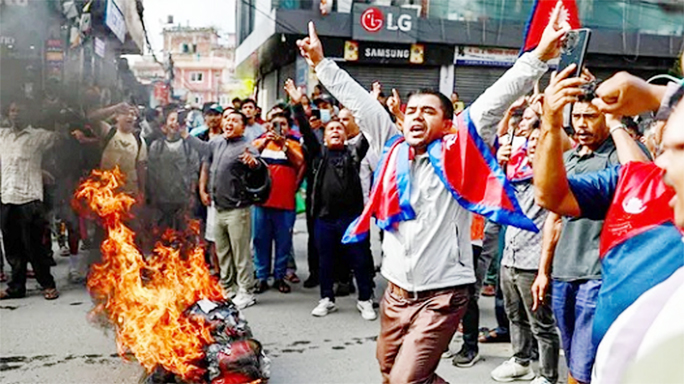
Nepal Prime Minister K.P. Sharma Oli has been forced to resign amid massive protests by students and the public. With his resignation, Nepal witnesses the fall of its 14th government in the past 17 years. In fact, political instability in Nepal began in 2008. Since then, in these 17 years, 14 governments have come to power none of which could complete their full five-year term.
Until 1951, Nepal was under a full monarchy.The kings of that time were known as the Ranas. Although there was a Prime Minister to assist them, the position of Prime Minister was determined by hereditary succession.
In 1951, however, a pro-democracy movement overthrew the Ranas. King Mahendra Bir Bikram Shah Dev came to power, and Nepal entered a parliamentary political system. But in 1961, King Mahendra banned political parties in Nepal. His aim was to consolidate power solely under the monarchy. However, a parliamentary system continued to exist, and members of parliament were elected, but they were not allowed to represent any political party.
After nearly three decades under this system, a public uprising began in 1990. To quell the protests, then-King Birendra Bir Bikram Shah Dev lifted the ban on political parties. Through this movement, Nepal entered a multiparty democratic system.
In 1996, the Maoist Communist Party of Nepal launched a movement demanding the abolition of the monarchy and the royalist parliamentary system. Over the decade-long struggle, more than 17,000 people lost their lives.
In March of this year, protests demanding the restoration of the monarchy began in Kathmandu. The situation required military deployment. Before six months had passed, the government led by K.P. Sharma Oli fell.
In 2006, the Maoists achieved final victory.The monarchy was abolished, and Nepal was recognized as a democratic republic. A new constitution was adopted in 2015.
However, after the abolition of the monarchy, Nepal entered a new phase of political instability. Since 2008, none of the governments in power have lasted more than two and a half years. The government led by Prime Minister K.P. Sharma Oli fell after just one year in office.