
101 teachers, students honoured with Academic Excellence Award at NSTU
NSTU Correspondent:
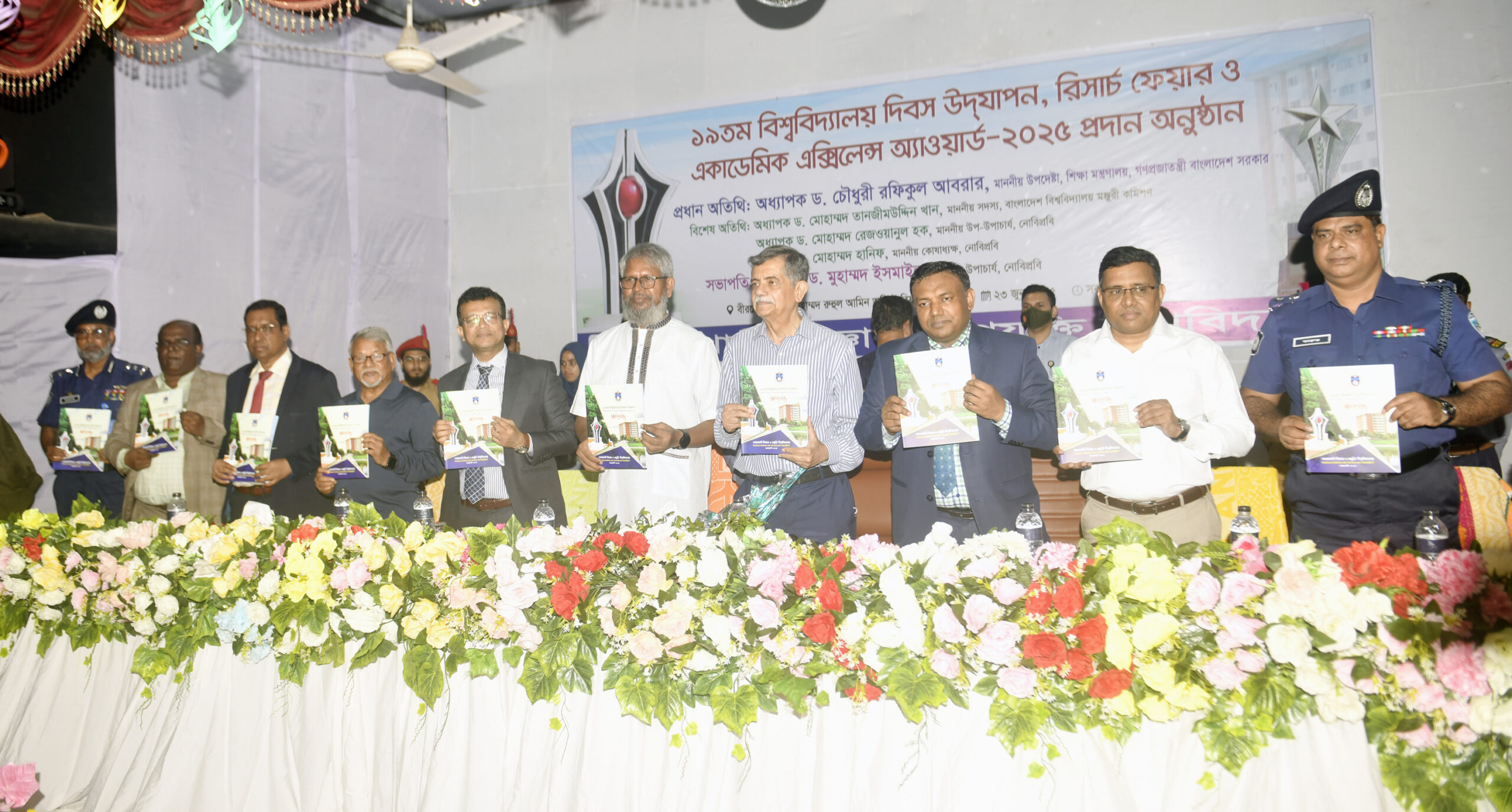
Noakhali Science and Technology University (NSTU) celebrated its 19th University Day on Monday with a series of events, including a research fair and the presentation of the Academic Excellence Awards. The daylong programme took place on June 23, 2025, and was attended by notable academic and administrative figures.
Professor Dr Chowdhury Rafiqul Abrar, Education Adviser to the Government of Bangladesh, attended the event as chief guest, while NSTU Vice-Chancellor Professor Dr Muhammad Ismail presided over the programme. Among the special guests were Cumilla University Vice-Chancellor Professor Dr Haidar Ali, NSTU Pro-Vice-Chancellor Professor Dr Md Rezwanul Haque, Treasurer Professor Dr Mohammad Hanif, former Acting Vice-Chancellor and Pro-VC Professor Dr Md Abul Hossain, Commandant of Noakhali Police Training Center DIG Md Haider Ali Khan BPM, Noakhali Deputy Commissioner Khandaker Istiak Ahmed, Superintendent of Police Md Abdullah Al Faruq, and Director of NSTU Research Cell Professor Dr Muhammad Shafiqul Islam.
The celebration began at 10:30 AM with the hoisting of the national flag and the release of balloons and doves near the administrative building, marking the inauguration of the research fair by the education adviser. He then visited various stalls set up by different departments, institutes, and student organisations showcasing their research and innovations.
During a formal ceremony at Birshreshtha Shaheed Ruhul Amin Auditorium, the education adviser awarded 70 faculty members with the Vice-Chancellor’s Award and Research Award, while 31 students received the Dean’s Award in recognition of their academic excellence. He also laid the foundation stones for several university infrastructure projects and announced the inauguration of various service and development initiatives.
In his speech, Professor Dr Chowdhury Rafiqul Abrar acknowledged the challenges faced by a relatively young university like NSTU, including accommodation and transportation issues for students, and limited research and lab facilities for faculty. “None of these concerns are insignificant. We are trying to address them based on priority,” he said.
He added, “I once believed I would die as a subject under authoritarian rule. But the youth have risen, resisted fascism, and driven it away. If a nation wants to eliminate inequality, education is its most powerful weapon. We must practice science, not blind faith, and ensure freedom of expression.”
Professor Dr Haidar Ali, VC of Cumilla University, praised the initiative and said, “The Research Fair and Academic Excellence Awards are timely initiatives that will promote research among teachers and encourage students toward academic achievement. We must adopt new educational models such as Outcome-Based Education (OBE) and skills-based learning.”
Vice-Chancellor Dr Muhammad Ismail, in his presidential address, highlighted several initiatives taken since assuming office. These included the establishment of a university ranking cell, enhanced PhD fellowships and research incentives, the introduction of the Dean’s and VC Awards, the foundation of an animal house, collaborations with reputed foreign universities, and the adoption of a double-blind coding system to prevent mark tampering.
He also mentioned improvements such as the distribution of first-aid kits across departments and offices, the installation of fire safety systems, addition of new ambulances and buses, and launching an updated, informative university website. Administrative reforms such as implementing an ACR system for staff and evaluation mechanisms for faculty were also introduced.
Dr Ismail expressed hope that NSTU would emerge as a leading higher education institution in the country and urged the education adviser to support the establishment of a Centre of Excellence, construction of student halls, and a TSC (Teacher-Student Centre).
Later in the day, the second session featured research presentations by faculty and students, followed by a cultural evening at the auditorium.
The event saw the participation of deans, directors, department heads, faculty members, students, staff, and officials from both the public and private sectors, as well as representatives of civil society and local public figures.